

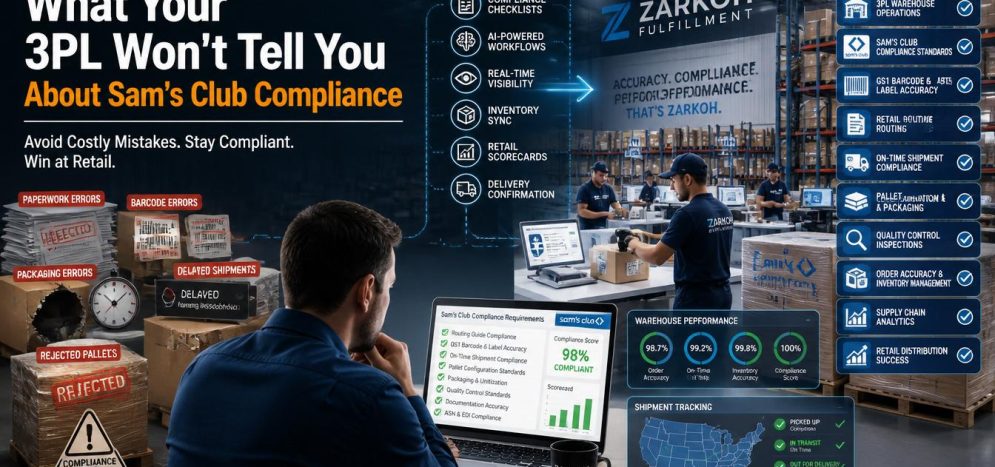
Sam’s Club plans to more than double its sales and membership over the next 8–10 years, supported by expanding its national eCommerce and fulfillment network.
Partnering with Sam’s Club Fulfillment Services is a massive milestone. It represents validation, scale, and life-changing revenue potential. You celebrate the big purchase order right away. You pop the expensive champagne with your team. You notify your third-party logistics provider immediately. Your warehouse partner smiles and nods their head. They assure you they handle bulk distribution easily.
Then the actual physical shipments begin to roll. A few weeks later, your financial dashboard looks terrible.
You start noticing random fee deductions on invoices. Hundreds of dollars disappear here and there. Thousands of dollars vanish without clear reasons why. You dig deeply into the actual data trail. You find many strict compliance penalty charges listed. These are not standard shipping or storage fees. They are systematic chargebacks from automated systems.
Standard ecommerce warehousing workflows do not work here. Your 3PL might ship single boxes very well. But enterprise retail compliance is a different beast. There are hidden friction points in this chain. Your fulfillment vendor will not tell you about them. You have to discover the problems on your own.
The Hidden Realities of Warehouse Club Compliance
1. The Strict Ban on Standard Pallets
Warehouse workers see pallets as simple wooden platforms. They use them to move heavy inventory around. Your 3PL will use standard grocery pallets normally. They use standard stringer platforms unless you stop them.
Those standard pallets will cause major delivery issues. The distribution center will reject the entire truckload instantly.
Sam’s Club enforces a very strict pallet mandate. They require specific forty-eight by forty-inch platforms. They demand certified nine-block pooled pallets every time. Forklifts must access the wood from all sides. The inventory must allow two-sided shopping floor access. Your product branding must face outward on adjacent sides. Warehouse teams cannot get lazy with stretch wrap. Allowing an inch of product overhang causes penalties. You will face an immediate structural chargeback fee.
2. The Nightmare of the Artificial Intelligence Exit Portals
Frictionless retail technology changes the modern checkout experience. Sam’s Club utilizes advanced computer vision systems now. They use AI-powered exit portals to scan full carts. The scanning happens automatically as members walk out the doors. This cutting-edge store technology places heavy burdens on you. It impacts your packaging logistics design choices directly.
Your product packaging must fit these AI sensors perfectly. Do not place reflective foils on top surfaces. Holographic details cause sensor glare under bright lights. The cameras fail to read the SKU numbers accurately. Large items require omnidirectional, repeating barcode patterns instead. Place them across multiple faces of the box clearly. The cart scanners must read them from any angle. Your 3PL cannot cover barcodes with shipping labels. Bad placement causes AI scan failures very quickly. Corporate chargeback fees flow straight back to you.
The Strict Reality of Supplier Performance Metrics
Automated performance dashboards monitor your operational health constantly. Every single mistake is logged and categorized automatically. The system penalizes errors based on a rigid schedule.
| Compliance Violation | The Root Cause in the Warehouse | The Immediate Financial Penalty | The Long-Term Operational Risk |
| SIDE Dimension Error | 3PL entered inaccurate weight or dimensions during setup | $637.97 flat fee plus $122.21 per location | Automated delivery blocks on future inventory |
| Late EDI 856 ASN | Warehouse team shipped the freight before sending data | $250.00 flat fee per single occurrence | Drastic reduction in supplier scorecard rating |
| Non-Compliant Pallet | Using standard stringer wood or allowing product overhang | Total load rejection at the bay door | Expensive carrier storage fees and missed windows |
| Barcode Scan Defect | Poor print quality or placing label over the product graphics | Per-item automated chargeback fees | Loss of prime physical shelf space inside clubs |
Understanding the True Cost of Data Inaccuracy
The Supplier Item Data Excellence program catches mistakes. It is commonly known as the SIDE system online. This automated system identifies data discrepancies very quickly. You onboard a product with specific weight numbers. Your 3PL provides dimensions for your retail inventory. The fulfillment partner might change your shipping carton sizes. They often do this without updating the central system. You slide into the danger zone right away.
The SIDE system enforces a ten percent tolerance window. Your actual physical dimensions must not deviate too far. Variations greater than ten percent trigger automated penalties instantly.
A single entry error results in heavy fines. You pay a large flat fee right away. You pay incremental penalties for every single store location. Those locations receive the incorrect inventory data updates. Your 3PL vendor rarely audits item data later. They alter their warehouse pack configurations to save money. They switch box sizes to reduce cardboard usage costs. You are left holding the bill for data errors.
Navigating the Timing of Electronic Ship Notices
Logistics is not just about moving physical boxes. It is about transmitting digital data accurately and quickly. A freight truck leaves a warehouse dock daily. An Electronic Data Interchange transaction must hit the network. This transaction is known as the EDI eight-fifty-six. It represents an Advance Ship Notice for the retailer.
The timing of this digital transmission matters immensely. Generate the ship notice after loading the trailer fully. The notice must clear the digital network completely first. It must beat the truck to the receiving gate.
Physical trucks often beat slow digital data transmissions today. This happens when 3PLs use manual data workflows. Delays until the end of the day cause issues. The inventory might arrive perfectly on time anyway. But a late ship notice triggers an automatic fine. You receive a two-hundred-fifty-dollar penalty daily. Your vendor might boast about physical shipping speeds often. But sluggish digital infrastructure costs you real money weekly. Compliance fines will drain your profits very fast.
Frequently Asked Questions
What does OTIF mean in club store logistics?
OTIF stands for On-Time In-Full metrics. It measures delivery accuracy within narrow time windows.
Can I use any standard wooden pallet for retail distribution?
No, standard stringer or GMA pallets are strictly prohibited. You must use certified nine-block pooled pallets instead.
Why does product packaging matter for retail compliance?
Store checkouts utilize AI computer vision and smartphone scanning. Packaging must feature high-contrast, non-reflective graphics always.
What happens if a shipment is rejected at the distribution center?
You must pay for the freight truck return delivery. You pay labor fees to fix the inventory issues.
How can I protect my brand from automated chargebacks?
You must mandate a strict retail compliance SOP document. Automate your EDI transmissions and conduct quarterly data audits.