

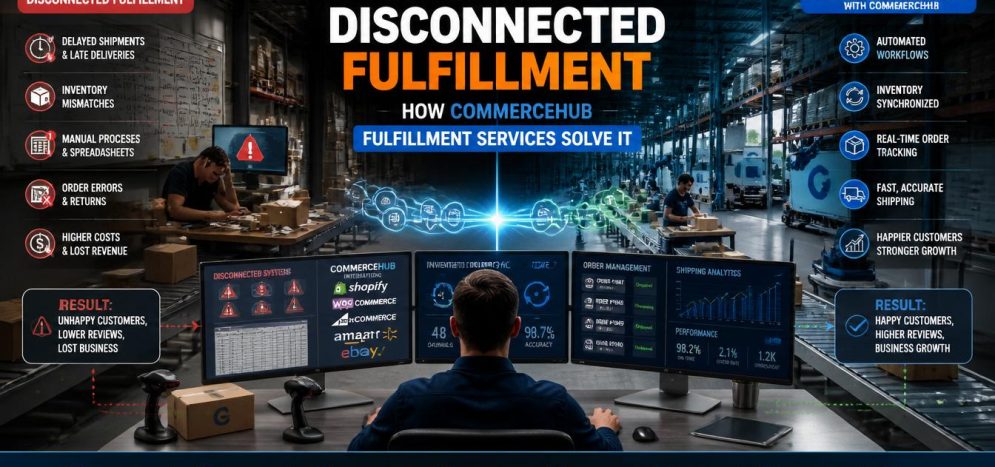
The warehouse manager was convinced the problem was on the shipping side.
The shipping team blamed inventory.
Customer support thought the warehouse was simply overwhelmed.
Turns out, none of them were completely right.
They just needed CommerceHub Fulfillment Services.
A retailer had oversold a kitchen appliance that had been sitting in three different systems with three different inventory counts. One marketplace showed eight units available. The warehouse management system showed five. The supplier had already shipped the remaining stock to another retailer.
By the time everyone realized what had happened, dozens of customers had already placed their orders.
That story is not unusual anymore.
It is actually one of the quieter problems in modern retail. You do not hear much about disconnected fulfillment because it is rarely dramatic. There is no single moment where everything breaks. Instead, small gaps appear between systems. Those gaps grow wider as a business expands, and eventually they start costing real money.
Most retailers notice the symptoms first. Orders arrive late. Inventory numbers stop matching. Customer service tickets pile up. Returns become harder to process. Shipping costs creep upward for reasons nobody can immediately explain.
The temptation is to fix each issue separately.
In reality, they often share the same root cause.
The systems responsible for fulfillment simply are not speaking the same language.
That is exactly the problem CommerceHub fulfillment services were designed to solve.
Success Is Followed by More CommerceHub fulfillment services
There is something almost ironic about retail growth.
The better your business performs, the better order fulfillment services for CommerceHub you require.
When you are shipping fifty orders a day, almost anything works. Someone can manually verify inventory if needed. A warehouse supervisor can catch mistakes before they become expensive.
At five thousand orders a day?
Good luck.
Now imagine selling through your own website while also fulfilling orders from Walmart, Target Plus, Amazon, and several specialty retailers. Some inventory sits inside your warehouse. Some is managed by suppliers. Some ships directly from manufacturers.
Everything looks organized until the first unexpected rush.
A flash sale starts.
One product suddenly becomes popular because an influencer mentioned it online.
Orders start arriving every few seconds.
That is when disconnected systems show their true colors.
Inventory updates begin lagging behind reality. One channel still shows products available while another has already sold out. Customer service receives messages asking why tracking information has not appeared yet.
Nobody intended for this to happen.
The business simply outgrew the systems holding everything together.
The Quiet Cost Nobody Puts on a Spreadsheet
Late deliveries are easy to measure.
Refunds are easy to measure.
Shipping expenses are easy to measure.
Trust is not.
Suppose you buy a birthday gift for your daughter.
The retailer promises delivery by Friday.
Friday comes and goes.
The package eventually arrives on Monday with a polite apology.
You might accept the apology.
You probably will not choose that retailer next time.
Businesses often calculate the refund.
They rarely calculate the customer they quietly lost.
That is where not using commercehub order fulfillment services becomes expensive.
Not because of one bad shipment.
Because hundreds of tiny disappointments slowly chip away at customer confidence.
Funny Thing About Inventory
People hear the phrase inventory visibility and immediately think about shelves.
Rows of boxes.
Warehouse scanners.
Forklifts.
Honestly, that is only part of the picture.
Inventory visibility is really about confidence.
Can your marketing team confidently promote a product?
Can customer service confidently promise delivery?
Can a marketplace confidently display availability?
Can purchasing confidently decide what needs replenishing?
If four departments give four different answers, the inventory problem has already escaped the warehouse.
CommerceHub Connects Conversations
CommerceHub does not magically create inventory.
It creates something almost as valuable.
Shared understanding.
Think about a relay race.
Each runner might be incredibly fast.
The race is still lost if nobody passes the baton cleanly.
Retail works the same way.
Suppliers know what they can produce.
Warehouses know what they can ship.
Retailers know what customers are buying.
Marketplaces know where demand is increasing.
The challenge has never been collecting information.
The challenge has always been moving that information quickly enough for everyone else to use it.
Fulfillment services for Commercehub sit in the middle of those conversations.
Orders flow where they need to go.
Inventory updates travel back across connected channels.
Partners spend less time emailing spreadsheets back and forth.
It sounds simple.
Simple is exactly what complicated operations need.
Here Is Where Things Usually Get Messy
Imagine selling espresso machines.
You have inventory in Nevada, Illinois, and Georgia.
A customer in Phoenix places an order.
Without intelligent routing, that order might leave Illinois because that warehouse happened to receive it first.
Nothing technically failed.
The customer still gets the product.
Except shipping costs are higher.
Delivery takes longer.
Another warehouse now has excess inventory while the closer one stays full.
Multiply that decision by ten thousand orders.
Now the numbers become interesting.
Small inefficiencies have a habit of becoming very expensive once volume increases.
Nobody Notices Good Fulfillment
This might be my favorite thing about retail operations.
Customers almost never compliment 3pl fulfillment for commercehub.
Nobody posts online because inventory synchronized correctly.
Nobody writes a glowing review because order routing worked exactly as intended.
Good fulfillment is invisible.
People notice when something goes wrong.
They rarely notice when everything quietly goes right.
Oddly enough, that is exactly the goal.
The smoother the process becomes, the less customers think about it.
Instead, they remember the brand.
Growth Should Not Create More Guesswork
Many companies assume scaling means hiring more people.
Sometimes it does.
But adding employees to disconnected systems usually creates more communication instead of better communication.
One team updates inventory.
Another verifies supplier availability.
Someone manually forwards purchase orders.
Someone else checks tracking information.
It becomes an endless chain of people passing information around.
Connected fulfillment changes that equation.
Instead of asking employees to compensate for disconnected technology, businesses allow technology to handle repetitive communication.
People spend more time solving meaningful problems.
Less time copying information from one system into another.
That is a surprisingly important difference.
Retail Has Changed More Than Most People Realize
Ten years ago, many retailers controlled almost everything themselves.
Today, success depends on partnerships.
Brands work with third-party logistics providers.
Suppliers ship directly to customers.
Marketplaces generate significant portions of online revenue.
Warehouses operate in multiple regions.
No single company owns the entire fulfillment process anymore.
CommerceHub recognizes that reality.
Rather than forcing every participant to work independently, it helps create a connected network where information moves continuously instead of stopping at every handoff.
A fulfillment company for commercehub feels less like a collection of separate businesses and more like one coordinated operation.
Final Thoughts
The biggest fulfillment problems rarely begin inside a warehouse.
They begin much earlier.
CommerceHub helps eliminate many of those invisible gaps by connecting retailers, suppliers, fulfillment partners, and marketplaces through a continuous flow of information.
Customers will never know an order was intelligently routed to a closer warehouse.
They will never notice inventory synchronized across several systems in seconds.
They are not supposed to.
They only notice that the product arrived exactly when you promised it would.
In retail, that is still one of the strongest competitive advantages you can have.
| Disconnected Fulfillment | CommerceHub Connected Fulfillment |
| Inventory updates happen at different times across channels. | Inventory information stays synchronized across connected partners. |
| Orders may be routed manually or through limited rules. | Intelligent routing helps send orders to the most suitable fulfillment location. |
| Teams spend time reconciling inventory discrepancies. | Shared data reduces manual reconciliation and operational friction. |
| Customer service handles more order status and stock inquiries. | Better visibility gives customers and support teams more accurate information. |
| Scaling often means adding more manual work. | Automation supports growth without increasing operational complexity. |
FAQs
What is CommerceHub fulfillment?
CommerceHub is a connected commerce platform that helps retailers, brands, suppliers, and marketplaces share fulfillment and inventory information more efficiently.
How does CommerceHub improve inventory visibility?
It synchronizes inventory data across connected systems, helping businesses maintain more accurate stock information across multiple sales channels.
Can CommerceHub work with third party logistics providers?
Yes. CommerceHub integrates with fulfillment partners, suppliers, and retailers to streamline order processing and inventory updates.
Why is connected fulfillment important for growing retailers?
As order volume and sales channels increase, connected fulfillment reduces manual processes, improves order accuracy, and helps prevent inventory discrepancies.
How does CommerceHub improve the customer experience?
By providing better inventory accuracy, smarter order routing, and more reliable fulfillment, CommerceHub helps retailers deliver orders with fewer delays and fewer stock-related issues.