

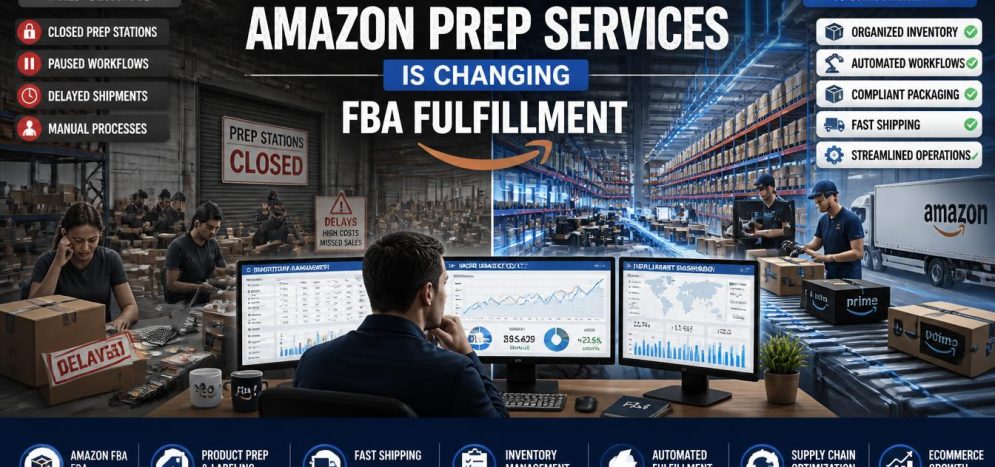
With Amazon ending its FBA Prep Service, sellers now have to make sure every product reaches the fulfillment center completely ready for storage and shipment. At first glance, it sounds like one more task added to an already long list. In reality, though, it’s a bigger shift than many people expected. It changes where inventory is prepared, who is responsible for quality control, and how businesses should think about Amazon SFP going forward.
For some sellers, this will only mean adjusting a few steps. For others, especially those with larger catalogs or international suppliers, it could require a complete change in how inventory moves from the factory to Amazon.
Why This Change Matters
Amazon fulfillment services are built for speed. Every minute employees spend labeling products or putting items into poly bags is time they are not spending receiving inventory or shipping customer orders.
By removing prep services, Amazon has shifted those responsibilities back to sellers. That allows fulfillment centers to focus on what they do best while encouraging businesses to arrive with inventory that is already compliant.
From Amazon’s perspective, it makes sense. From a seller’s perspective, it means the margin for error has become much smaller.
A shipment that arrives without the proper labels or packaging is no longer something Amazon fixes for a fee. Instead, it can create delays, rejected inventory, or additional costs that are often much higher than preparing the products correctly in the first place.
The New Reality for FBA Sellers
Think about a small business that imports kitchen accessories from overseas.
A few years ago, the owner could receive products from the manufacturer, send them to Amazon, and pay Amazon to finish the preparation work. It wasn’t the fastest option, but it reduced the amount of work happening before shipment.
Now imagine that same business today.
Every unit has to be labeled correctly. Products that require poly bags must already have them. Bundles need to be assembled before shipping. Fragile items should already be protected. If any of those steps are missed, the shipment may not move through Amazon’s network as expected.
That means preparation has moved much earlier in the supply chain.
Instead of asking, “Will Amazon take care of this?” sellers now have to ask, “Is this ready before it ever leaves my warehouse?”
It sounds like a small difference. Operationally, it’s a major one.
Inventory Planning Has Become More Important
One of the biggest mistakes sellers make is assuming they can prepare inventory at the last minute.
That approach becomes much riskier now.
Imagine you notice your best-selling product has only two weeks of inventory left. Your replacement shipment is still sitting at your warehouse waiting for labels, inspections, and packaging. Every extra day spent getting products ready increases the chance of running out of stock.
Running out doesn’t just hurt sales for a few days. It can affect your product ranking, advertising performance, and customer momentum. Recovering from that can take weeks.
Many experienced sellers are now building extra preparation time into every shipment. Instead of treating prep as the final task before shipping, they’re making it part of the production schedule from the beginning.
It’s a small mindset change, but it prevents a lot of unnecessary stress.
Quality Control Is No Longer Optional
Preparation isn’t only about sticking labels on products.
This is actually a good opportunity to catch problems before customers ever see them.
Suppose you’re selling reusable water bottles.
While applying labels, someone notices that several bottles have scratched lids. Another box contains bottles with the wrong color variation. Without a quality inspection, those products could have gone straight to Amazon, where they would eventually reach customers.
Now you’re dealing with returns, negative reviews, and replacement costs.
A quick inspection before shipping often costs much less than fixing those problems after the products are already inside Amazon’s network.
This is one reason many growing brands are putting more emphasis on quality checks than they did in the past.
International Sellers Face Bigger Challenges
If your products come from another country, the change can feel even more significant.
Manufacturers usually do an excellent job producing products, but they don’t always specialize in Amazon’s constantly changing packaging requirements.
One shipment might arrive perfectly prepared. The next shipment might have labels placed incorrectly or missing entirely.
That inconsistency creates unnecessary risk.
Many sellers are solving this by routing inventory through a prep center before it reaches Amazon. The prep team checks each shipment, fixes any issues, applies labels if needed, and verifies that everything meets Amazon’s requirements.
It adds one stop to the journey, but it often prevents much bigger problems later.
Why Prep Centers Are Becoming More Valuable
Independent prep centers have existed for years, but many sellers viewed them as optional.
That perception is changing quickly.
Today, a good prep center does far more than print labels.
Many inspect products, count inventory, create bundles, repackage damaged cartons, organize shipments, and communicate directly with sellers when something doesn’t look right.
Think of them as a quality checkpoint between your supplier and Amazon.
For businesses shipping thousands of units every month, that checkpoint can prevent expensive mistakes.
Even smaller sellers are finding value in outsourcing prep. Instead of spending evenings applying labels or assembling bundles in a garage or small warehouse, they can focus on sourcing products, improving listings, or growing their brand.
Time has always been valuable. Now it’s becoming one of the biggest competitive advantages a seller has.
So, What Should Sellers Do Now?
The first step is accepting that prep is no longer something that happens after your products reach Amazon. It’s now part of your inventory strategy.
That might sound obvious, but it’s a shift in thinking.
Instead of treating preparation as a final checklist, start planning for it when you place your purchase order. Ask your supplier what they can handle. Decide which tasks should happen at the factory and which are better handled by a prep center. Build a little extra time into your shipping schedule instead of hoping everything goes perfectly.
You probably won’t notice much difference on your first shipment. Over the course of a year, though, those small decisions add up. Fewer delays. Fewer rejected shipments. Less scrambling when inventory runs low.
Should You Handle Prep Yourself?
It depends on the size of your business.
If you’re shipping a few dozen units every month, preparing inventory yourself might still make sense. You stay in control, and the cost of supplies is manageable.
Now imagine you’re shipping 3,000 units across multiple SKUs.
Suddenly you’re printing thousands of labels, checking products, assembling bundles, packing cartons, and making sure everything follows Amazon’s requirements. That’s no longer a side task. It’s practically another business.
At that point, many sellers realize they’re spending more time managing logistics than growing their brand.
That’s where outsourcing starts to make financial sense.
What a Good Prep Partner Brings to the Table
Not every prep center offers the same level of service.
Some simply apply labels and ship your inventory. Others become an extension of your operations.
A reliable prep partner can usually help with:
- FNSKU labeling
- Poly bagging
- Bubble wrapping
- Kitting and bundling
- Product inspections
- Carton forwarding
- Inventory storage
- Shipment creation
- Returns processing
- Quality control
Those services may seem routine, but together they remove a huge amount of operational pressure.
If a supplier accidentally sends the wrong color, a damaged carton, or incorrect quantities, a prep center often catches the issue before Amazon ever receives the shipment.
That alone can save countless hours.
Comparing FBA Fulfillment Before and After the Change
| Area | Before Amazon Ended Prep Services | After Amazon Ended Prep Services |
| Product labeling | Amazon could apply labels for a fee | Sellers or prep centers must apply labels before shipping |
| Packaging | Amazon handled many prep tasks | Inventory must arrive fully prepared |
| Compliance | Amazon assisted with some preparation | Sellers are fully responsible |
| Quality checks | Often skipped until products reached Amazon | Better performed before shipping |
| Inventory planning | More flexibility | Requires additional lead time |
| Third-party prep centers | Helpful but optional for many sellers | Becoming a key part of many fulfillment strategies |
The biggest takeaway isn’t that fulfillment has become harder.
It’s that the work has moved earlier in the process.
A Different Way to Think About Fulfillment
Many sellers see fulfillment as the moment products leave for Amazon.
That’s becoming outdated.
Today, fulfillment starts much earlier.
It begins when you communicate packaging requirements to your supplier. It continues through inspections, labeling, shipment planning, and quality control. By the time your products reach an Amazon fulfillment center, there should be very little left to do.
Businesses that understand this tend to experience fewer surprises.
Those who don’t often find themselves dealing with shipment delays, compliance issues, and emergency inventory shortages.
It’s less about working harder and more about building a smoother process.
Looking Ahead
Amazon rarely makes changes without a long-term goal.
Ending prep services is another step toward a fulfillment network where every shipment arrives standardized and ready to move immediately.
That trend is unlikely to reverse.
In fact, many industry experts expect Amazon to continue placing more operational responsibility on sellers while focusing its own resources on speed, automation, and customer delivery.
For sellers, that means investing in stronger systems instead of relying on Amazon to solve operational problems.
The businesses that adapt early usually gain the advantage.
Final Thoughts
At first, Amazon ending its prep services felt like bad news to many sellers.
In some ways, it does create more work. There’s no point pretending otherwise.
But it also encourages businesses to build better supply chains.
Instead of depending on Amazon to fix inventory issues after products arrive, sellers now have the opportunity to catch problems earlier, improve quality control, and create a more reliable fulfillment process.
The businesses that succeed over the next few years probably won’t be the ones working the hardest. They’ll be the ones building systems that keep inventory moving with fewer interruptions.
That’s really what this change is about.
Amazon hasn’t made fulfillment impossible.
It’s simply changed where the work happens.
Frequently Asked Questions
Q1: Why did Amazon end its FBA Prep Service?
A: Amazon removed the service to improve efficiency inside its fulfillment centers. By requiring inventory to arrive fully prepared, the company can focus more on receiving, storing, and shipping products instead of performing preparation tasks.
Q2: Can I still send products that need labels or poly bags?
A: You can, but those tasks must be completed before the shipment reaches Amazon. Products that don’t meet Amazon’s requirements may be delayed or rejected.
Q3: Is using a prep center worth the cost?
A: For many sellers, yes. A prep center can reduce manual work, improve quality control, and help prevent costly compliance mistakes, especially as order volumes increase.
Q4: Will this affect small Amazon sellers?
A: Absolutely. Small sellers may feel the impact first because they often prepare inventory themselves. Planning ahead and using outside help when needed can make the transition much easier.
Q5: What’s the biggest lesson sellers should take from this change?
A: Preparation is no longer the last step before Amazon receives your products. It has become an essential part of inventory planning, and businesses that treat it that way will be in a stronger position as Amazon’s fulfillment network continues to evolve.